Showing posts with label Christ. Show all posts
Showing posts with label Christ. Show all posts
Sunday, November 30, 2014


Monday, July 7, 2014
The Everyday Power of C.H.R.I.S.T. FHE lesson idea
Here is another great idea for a Family Home Evening lesson from The Red Headed Hostess:
The Everyday Powers of C.H.R.I.S.T.
“I need thee ev’ry hour, Most gracious Lord”
(Hymns no. 98)
I clearly recall hearing the musical number, “I Need Thee Every Hour” (Hymns, no. 98) be sung when I was a teenage boy, sitting in my hometown LDS chapel. I also clearly remember the somewhat unsettling thought that came to my mind when pondering the message of that hymn—of my need for Jesus every hour.
I need thee ev’ry hour, Most gracious Lord…
“Not EVERY hour,” I reasoned.
I need thee, oh, I need thee…
“Well, I will need Jesus when I die and need to be resurrected. And I know I need Jesus when I sin and want to be forgiven of my sins. But sin and death doesn’t mean I need Jesus every HOUR of every day. Why would I need the Atonement every hour?”
The question of my youth wasn’t—and isn’t for most disciples of Christ—the simple, “Why do we need Jesus’ Atonement?” That, I think, is strongly understood by most Latter-day Saints, and was clearly understood by me in my youth. But the question of why I would need Jesus’ Atonement every hour of my life, especially in the non-sin/repentance contexts of everyday life, and how that is made possible, weren’t so obvious to me then, nor are the overtly obvious to many believers today. Most Latter-day saints tend to associate the direct application of Jesus’ Atonement to sin and/or death. President Boyd K. Packed said, “For some reason, we think the Atonement of Christ applies only at the end of mortal life to redemption from the Fall, from spiritual death. It is much more than that. It is an ever-present power to call upon in everyday life….The Atonement has practical, personal everyday value.”
Aside from forgiveness and resurrection, what practical, personal, everyday value does the Atonement of Christ offer? For example, how does the Atonement help somebody who just got divorced? What about someone who just got denied to graduate school? What about the person dealing with infertility? How does the Atonement relate to those to whom nobody relates—those who are outcasts and not in any real circle of family or friends? What about the person who is falsely accused or wrongly charged? How does the Atonement help the person who is unfairly treated? What does the Atonement do for someone who suffers daily from painful childhood memories? What payments can the Atonement bring to someone who was blindly robbed of life savings in a fraudulent investment scheme? What everyday power does the Atonement offer to someone with everyday back pain, or chronic fatigue, or chronic depression? How does the Atonement help the great-grandmother isolated in a senior care center? What does the Atonement do for the parent with a demanding special-needs child? What does the Atonement do for someone who can’t control their violent temper? Where does the Atonement come into effect not the sinner, but the sinned against, such as a person who has been devastated by an unfaithful spouse? And—let’s not overlook this small segment of saints—what does the Atonement do for the rare for whom “all is well”—the small segment of saints who are currently blessed with a good family and marriage, friends, personal health, comfortable living circumstances, and not involved in major sin? How can Jesus Atonement give an ever-present power in everyday life for the everyday person? That is where the real questions are, and I believe, real answers may be found.
Elder Russell M. Nelson said, “Each day, ours is the challenge to access the power of the Atonement.” As I have studied and searched the scriptures for insights to this challenge I have been drawn to the various examples that display Jesus’ divine grace in operation—varied situations, stories, and teachings where someone was somehow assisted by the powers of Christ. There are scriptures of people being raised from the dead and being forgiven of sin (sin and death). But there are also scriptures of people being healed from sickness (mentally and physically). Tears of sorrow are turned to tears of celebration. The hopeless are somehow given hope. Wrongs are made right. People are given divine protection and guidance. Needs are met. Comfort provided. There are examples of people being given power to do good works they otherwise couldn’t have done themselves: Joseph Smith translating, Nephi bursting bands, Moses parting the Sea. There were also examples of people, such as Paul, Peter, Alma the Younger, and the people of Mosiah, having their very natures and dispositions changed. The everyday powers of Christ spill out in the lives of God’s children in story after story throughout the scriptures, and thus can and do stream into the everyday lives of God’s children today.
Right now I am currently working on a book that attempts to synthesize and discuss what these various everyday powers of the Atonement are, what they look like, and how to possibly access them, which is where you (dear blog reader) may come in. One of the truths I discuss is that “Christ” isn’t a name, it’s a title (Greek for “anointed”)—a title that implies his anointed, everyday power. C.H.R.I.S.T. can actually be viewed and used as an acronym to teach and remind us of his ever-present, daily powers:
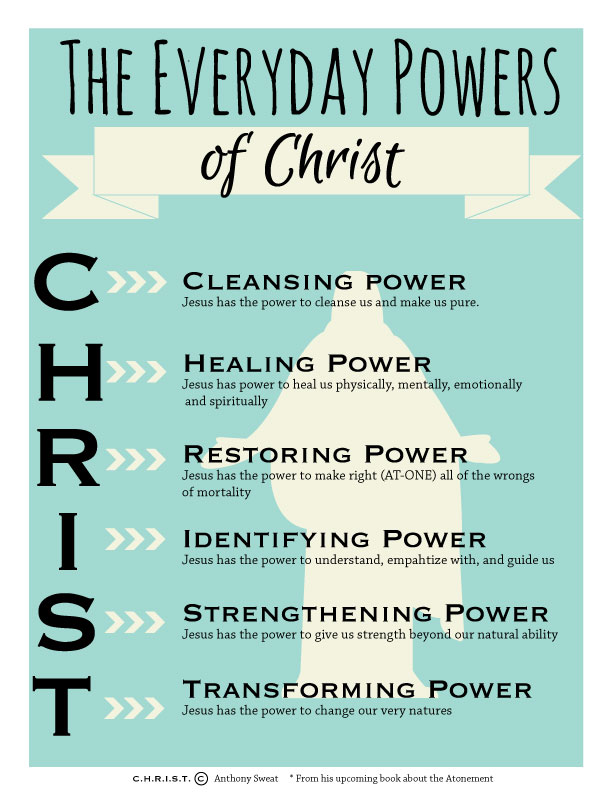
Cleansing power—Jesus has the power to cleanse us and make us pure.
Healing power—Jesus has the power to heal us physically, mentally, emotionally, and spiritually.
Restoring power—Jesus has the power to make right (at-one) all the wrongs of mortality.
Identifying power—Jesus has the power to understand, empathize with, and guide us.
Strengthening power—Jesus has the power to give us strength beyond our natural ability.
Transforming power—Jesus has the power to change our very dispositions and natures.
(Here is a PDF of the acronym picture above) Everyday power of C.H.R.I.S.T.
To better help readers understand how some of these powers not just theoretically work, butcurrently are at work, I am looking for some real life examples of others’ everyday experiences with the Atonement, and as many as possible. Consider the following questions:
- When and how have you been blessed by Jesus’ ability to empathize with you and understand what you are going through?
- When and how have you felt the Atonement of Christ heal you, physically, emotionally, mentally, or spiritually?
- What has been your experience with being cleansed from sin by Christ?
- When have you been given specific, inspired instructions or directions from God to overcome and/or meet your needs?
- How has your belief in the concept of divine restoration (where God will correct the wrongs of mortality) influenced your everyday actions?
- How has the gift of hope through the Atonement of Christ helped you deal with the inequities and unfairness of life?
- When have you been strengthened by Christ to do good works you otherwise would not have been able to perform without his help?
- In what ways and how has the Atonement of Jesus Christ changed your attitude, desires, disposition, or character—literally transformed you?
I would be honored and privileged to read and learn from your insights and experiences that might contribute to helping improve the content of this book. If you have something you would be willing to share in response to any of these questions (or ones similar) please click here (www.anthonysweat.com/contact) to contact me and share your experience. Any experience that ends up being used will have the identities and circumstances (places, dates, etc.) changed to protect person’s identities and provide anonymity. In advance I deeply thank anyone who is willing to share.
It is my belief that the Savior’s divine Atonement has something to offer everyone, every day, every hour. The Atonement of Jesus Christ is gratefully there for all of us who are stained by sin and long to be spotless. But it is also for the hurt who are holding out for healing; it is for those who have faith in a God that is fair, but who innocently suffer in a world that is often isn’t; it is for the burdened believer who seeks strength to meet the daily challenges of life; for the person who thinks that nobody understands their singular situation, but wishes someone would; it is for those who yearn for personal transformation and for their character to be more like Christ’s; it is for each of us who, in our unique situations, need the Atonement and Jesus’ divine grace this very hour, and every coming hour.
Sunday, December 29, 2013
Sunday, December 22, 2013
Sunday, December 15, 2013
Sunday, December 8, 2013
Sunday, December 1, 2013
Saturday, December 24, 2011
Monday, December 19, 2011
A Provocative Icon
A Provocative Icon
The silent Christ statue speaks to employees in ways that cut across religion, nationality, class and culture
Here in a hospital famed for modern medicine, a 10-and-a-half-foot marble statue of Jesus rises beneath its historic dome. Elsewhere, such a prominently featured religious symbol might be cause for controversy. But at Hopkins Hospital, "Christus Consolator" has managed to defy its traditional symbolism and garner respect from nearly all who pass.
Long a source of solace and hope for patients and families, the Christ statue also has meaning for hundreds of employees. For many it signifies healing, hope and compassion; for others, it means faith and tradition and even freedom. To a few, it is simply a work of art, or even a throw-back to a less tolerant time. Muslims, Jews, Christians, atheists-all interpret the statue in ways that feel right for them.
Claudia Costabile, an administrative assistant for Johns Hopkins International, moved here from Brazil last year. The statue doesn't seem out of place to her, she admits, perhaps because she was raised in a Catholic country. "I cannot separate the sculpture from my upbringing. When I look at it, I immediately think of my family." In Islam, says International client coordinator Omar Zidi, while Jesus has a very special place as a messenger, a key principal is to keep God in the abstract and eschew images of God or the prophets. But, he says, "It's hard to satisfy everybody. So for me, the statue serves as a reminder of my own faith."
Some like Adrian Dobs, professor of medicine and a practicing Jew, are less accepting of the statue. "I see how the statue means a great deal to our patients and their families. It engenders a sense of hope and comfort to many-something extremely important in the field of medicine," Dobs says. "But if it weren't already there, I wouldn't be in favor of erecting it again. It has an obvious religious significance, and in today's world, we need to be careful about imposing religious beliefs on others."
That's not an issue for Mikyong Hong, a patient services coordinator and interpreter for international services. Hong, who came to Hopkins a month ago from Korea, is an atheist but says the statue doesn't bother her. She points out that many religious Asians-many of whom are Buddhist-could be uncomfortable with the size and meaning of the statue and would avoid passing it. When Hong arrived at Hopkins, someone told her it was good luck to rub the statue's toe. "Now it's a habit," she says. "Every time I pass, I rub it."
Stop for a while and watch the people hurrying past the Christ statue. Not one five-minute period goes by without someone acknowledging it. Like Hong, they might rub the toe. Or, they might say a brief prayer. Some kneel in front of it. A few even high-five it. "Every time I walk by I have to touch it," says Norma Green, a transplant finance coordinator who has been at Hopkins for 37 years. "I leave all my problems there so I don't bring them to the patients.."
Founder Johns Hopkins was an ardent Quaker devoted to the establishment of a non-sectarian university, hospital and medical school. To Hopkins, "non-sectarian" meant acknowledging the power of personal faith without aligning his institutions with one particular religion. In 19th century parochial Baltimore, such a philosophy was considered heretical.
So when the University was dedicated in 1876 without so much as a benediction, many Baltimoreans considered it blasphemous. For years the rich and religious hounded the University's first president Daniel Gilman about the oversight. Finally, on Oct. 14, 1896, Gilman quelled the controversy with the stunning statue that stands at what was then the physical epicenter of the hospital, its ornate rotunda. He downplayed Jesus' religious implications; to him the statue represented the ultimate physician, the "Great Healer," who "wrought," he said, "more wonderful cures than any physician or surgeon that had ever lived."
Today, many share Gilman's take on the statue as a symbol of healing. Kate Hicks, raised Catholic, now not religious, says that when she joined Hopkins as a research data assistant in the Department of Psychiatry she heard the statue was a Greek medical figure. "I still think it's a beautiful work of art even though now I know it's Jesus, but I'd get more out of it if it were something different-maybe a human assisting another human. Something more about helping or healing than a religious figure."
For people like Nadia Sawaya, the statue represents much more. Sawaya lived through civil war in her native Lebanon, witnessing burning churches and other acts of violence fueled by religious differences. Today she is a project manager for external communications for Johns Hopkins International. "When I see the statue standing there without being torn down, it feels like freedom to me," she says. "It reminds me that in this country you can be proud of your faith, that you will be respected as a human being and a citizen no matter what you believe."
Cardiac surgeon Levi Watkins, a longtime civil rights activist, has brought everyone from Rosa Parks to Maya Angelou to see the statue. For him, it's not just a symbol of compassion and healing, but activism. "Jesus talked about feeding the poor, like some sort of ancient welfare system," he says. "The statue should remind us of our charitable mission here."
Situated in the historic Billings Administration Building, the iconic landmark is a stopping-off point for sight-seers, a starting point for Christmas carolers, and a gathering place for employees meeting for lunch. Although people from so many cultures pass through daily, very few official complaints about the statue have been recorded. No one would know better than Sandy Johnson, the employee orientation program coordinator for the Hospital and Health System who conducts weekly tours that always end at the statue. "I've been doing this seven years and I've never had a negative response from anyone. I've had everyone from Muslim to Baha'i in my tour groups. I think people just respect it as a symbol of faith, period."
For more than a century, the statue has left an indelible first impression on both patients and staff. "Every once in a while, I'll just stop and watch what's going on," says neurologist Michael A. Williams. "When you see how many people come to that statue, it tells you the value of faith and spirituality that people hold and maybe speaks louder than any spreadsheet could for enhancing our ability to give, not only through a beautiful silent statue, but through the services we provide here."
The silent Christ statue speaks to employees in ways that cut across religion, nationality, class and culture
 |  | |||
|
Long a source of solace and hope for patients and families, the Christ statue also has meaning for hundreds of employees. For many it signifies healing, hope and compassion; for others, it means faith and tradition and even freedom. To a few, it is simply a work of art, or even a throw-back to a less tolerant time. Muslims, Jews, Christians, atheists-all interpret the statue in ways that feel right for them.
Claudia Costabile, an administrative assistant for Johns Hopkins International, moved here from Brazil last year. The statue doesn't seem out of place to her, she admits, perhaps because she was raised in a Catholic country. "I cannot separate the sculpture from my upbringing. When I look at it, I immediately think of my family." In Islam, says International client coordinator Omar Zidi, while Jesus has a very special place as a messenger, a key principal is to keep God in the abstract and eschew images of God or the prophets. But, he says, "It's hard to satisfy everybody. So for me, the statue serves as a reminder of my own faith."
Some like Adrian Dobs, professor of medicine and a practicing Jew, are less accepting of the statue. "I see how the statue means a great deal to our patients and their families. It engenders a sense of hope and comfort to many-something extremely important in the field of medicine," Dobs says. "But if it weren't already there, I wouldn't be in favor of erecting it again. It has an obvious religious significance, and in today's world, we need to be careful about imposing religious beliefs on others."
That's not an issue for Mikyong Hong, a patient services coordinator and interpreter for international services. Hong, who came to Hopkins a month ago from Korea, is an atheist but says the statue doesn't bother her. She points out that many religious Asians-many of whom are Buddhist-could be uncomfortable with the size and meaning of the statue and would avoid passing it. When Hong arrived at Hopkins, someone told her it was good luck to rub the statue's toe. "Now it's a habit," she says. "Every time I pass, I rub it."
Stop for a while and watch the people hurrying past the Christ statue. Not one five-minute period goes by without someone acknowledging it. Like Hong, they might rub the toe. Or, they might say a brief prayer. Some kneel in front of it. A few even high-five it. "Every time I walk by I have to touch it," says Norma Green, a transplant finance coordinator who has been at Hopkins for 37 years. "I leave all my problems there so I don't bring them to the patients.."
Founder Johns Hopkins was an ardent Quaker devoted to the establishment of a non-sectarian university, hospital and medical school. To Hopkins, "non-sectarian" meant acknowledging the power of personal faith without aligning his institutions with one particular religion. In 19th century parochial Baltimore, such a philosophy was considered heretical.
So when the University was dedicated in 1876 without so much as a benediction, many Baltimoreans considered it blasphemous. For years the rich and religious hounded the University's first president Daniel Gilman about the oversight. Finally, on Oct. 14, 1896, Gilman quelled the controversy with the stunning statue that stands at what was then the physical epicenter of the hospital, its ornate rotunda. He downplayed Jesus' religious implications; to him the statue represented the ultimate physician, the "Great Healer," who "wrought," he said, "more wonderful cures than any physician or surgeon that had ever lived."
Today, many share Gilman's take on the statue as a symbol of healing. Kate Hicks, raised Catholic, now not religious, says that when she joined Hopkins as a research data assistant in the Department of Psychiatry she heard the statue was a Greek medical figure. "I still think it's a beautiful work of art even though now I know it's Jesus, but I'd get more out of it if it were something different-maybe a human assisting another human. Something more about helping or healing than a religious figure."
For people like Nadia Sawaya, the statue represents much more. Sawaya lived through civil war in her native Lebanon, witnessing burning churches and other acts of violence fueled by religious differences. Today she is a project manager for external communications for Johns Hopkins International. "When I see the statue standing there without being torn down, it feels like freedom to me," she says. "It reminds me that in this country you can be proud of your faith, that you will be respected as a human being and a citizen no matter what you believe."
Cardiac surgeon Levi Watkins, a longtime civil rights activist, has brought everyone from Rosa Parks to Maya Angelou to see the statue. For him, it's not just a symbol of compassion and healing, but activism. "Jesus talked about feeding the poor, like some sort of ancient welfare system," he says. "The statue should remind us of our charitable mission here."
Situated in the historic Billings Administration Building, the iconic landmark is a stopping-off point for sight-seers, a starting point for Christmas carolers, and a gathering place for employees meeting for lunch. Although people from so many cultures pass through daily, very few official complaints about the statue have been recorded. No one would know better than Sandy Johnson, the employee orientation program coordinator for the Hospital and Health System who conducts weekly tours that always end at the statue. "I've been doing this seven years and I've never had a negative response from anyone. I've had everyone from Muslim to Baha'i in my tour groups. I think people just respect it as a symbol of faith, period."
For more than a century, the statue has left an indelible first impression on both patients and staff. "Every once in a while, I'll just stop and watch what's going on," says neurologist Michael A. Williams. "When you see how many people come to that statue, it tells you the value of faith and spirituality that people hold and maybe speaks louder than any spreadsheet could for enhancing our ability to give, not only through a beautiful silent statue, but through the services we provide here."
- Lindsay Roylance
 | ||||
|

Friday, November 13, 2009
Thanks Challenge

I'm grateful for a road map in my life that points me in the direction I need to go, though I don't see the end I know the beginning. I know the person with the heavenly GPS knows the way for me, if I would just listen.
You're Never Alone Video
Subscribe to:
Posts (Atom)